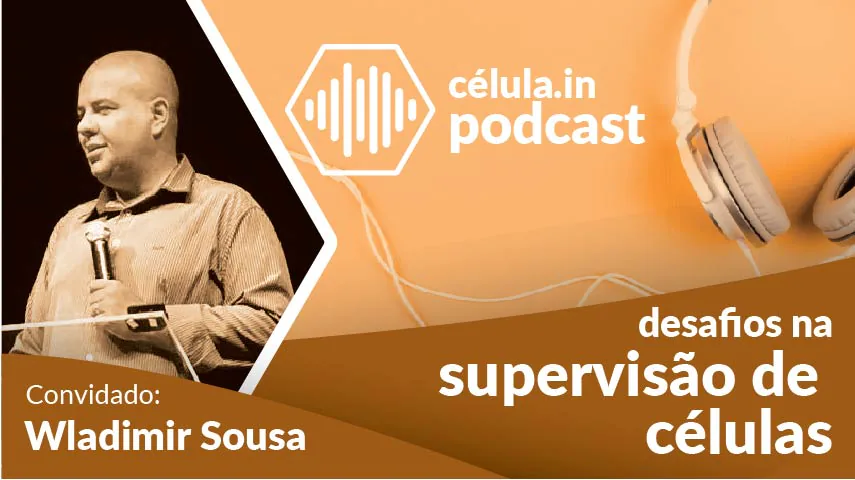
Wladimir, introduce yourself to us and tell us a bit about the IBVB.
I am a pastor in the interior of Minas Gerais, in the city of São Sebastião do Oeste, a city of 8,000 inhabitants where we have built a church. We have done this through the cell-group model, with the vision of growth and multiplication.
The church grew beyond the limits of the municipality, and it was necessary to open cell groups in Divinópolis and other neighboring cities.
In São Sebastião do Oeste we have 43 cell groups, with 411 people participating in small groups, that is, 5% of the population. We also have 8 groups in other cities.
It is a Baptist church and we have an alliance with the Formiga Valley of the Blessings Baptist Church, owned by Pastor Alvim Silva, who is our Pastor.
I believe that most people are in the urban part of the city, is that right?
Yes, but the city has a small urban perimeter, the urban region is around 19 km. So most of the people are in the rural area.
Do you have any specific job to bring those who attend rural cell groups to worship?
We have some challenges in this regard. There are many people who have a more fragile economic situation and do not have their own transportation.
Then what happens? The church has transportation, that is, we have some of our own vehicles that transport those that do not have their vehicles.
In cities there are internal mobility difficulties, because there is also no public transport. So we chartered a bus to help these people get together for the celebration services.
I believe that the issue of connectivity, even internet access, is perhaps a little more difficult, more limited. Right?
Without a doubt! We don't have the structure of large centers, there are many areas where there is no internet signal.
We know that for a cell-based church communication is essential, good cell group supervision is essential.
With the problem of lack of connectivity, how do you work on top of that?
The connectivity difficulty is evident, there are even obstacles to talking on the phone, it's not just internet access. There are places where sometimes a person has to walk maybe 1 km, 2 km, to be able to talk on the cell phone.
This impacted the delivery of cell group reports, even though we had been working with célula.in a few years ago, we were always faced with the delay in delivering supervisory reports.
How do you get the cell groups' frequency releases?
In the beginning, we were doing something in parallel. People filled out a paper form and took it to our cell group office, then it was released on célula.in. But that way it delayed our process. It worked for a long time, but it was ineffective.
After the many conversations I had with Alex, he gave us a suggestion that actually solved this problem.
Although I understand that the cell-based church has a very strong emphasis on relationships, the way we transmitted information was through a paper form, that is, a relationship did not exist.
So we had the idea that helped us a lot. The cell group leader would have more personal contact with their supervisor to pass on this information, that is, to transform this difficulty of virtual contact into intentional relationships. To generate opportunities for even more personal oversight.
Well, based on this idea, we created our own system, a routine that consists of stipulated deadlines for completing the cell group report online in the célula.in app. For the remaining ones, the leader should contact the supervisor.
Does it end there? No. Because, after these deadlines, whatever is missing, which is normal to happen, the supervisor contacts the leader to understand why he was unable to comply and to help him overcome such difficulties.
So did a major problem end up being converted into actions to improve oversight and the relationship between leader and supervisor?
Yes, and that helped us a lot, because it brought people into the system in a more effective way and gave us the security of real information.
We noticed that people often don't fill out the attendance report, it's not just because they don't want to, they don't understand the importance of it.
It is logical that it is a continuous challenge, but we achieved a high assertiveness index.
And how has that changed in the decision-making that you need to make on a daily basis?
I believe that the church of our day has never been so dynamic. The time we are living in requires quick decisions and immediate solutions.
Sometimes someone starts to experience a problem and what happens? She stops going to the service, she stops going to the small group meeting and now, we have this information almost in real time.
We are still working, we don't have anything effective, but we make a comparison between church services and cell groups, and with the speed of this information it is easier to identify some behaviors of our members that attract our attention.
If the person started to miss a meeting frequently, if I had the previous routine I would only know when I released the report for the entire month.
With the célula.in app we can take better care of people.
How do you convey to supervisors the importance of supervisory reporting?
We realized that there were supervisors who didn't see such importance in information. They did it out of obedience, but they couldn't see how much that information, being correct and timely, would help us.
We work on this in our oversight meetings. Routinely, we evaluate the information, that is, based on the indicators that we have available in célula.in and we begin to show data that is important to them.
I show them that the more the information is correct in the monthly cell group report I can get a better picture of how the church is doing.
For example, today we know that 48% of the people who attend our cell groups are under 16 years old.
Our child cell groups are a large volume of that audience. I think it's very important to know what audience we're dealing with.
“Oh, there are four hundred and so many people”, but another 200 or very close to that are children, and then, as pastors, we have to make a lot of decisions.
Even decisions regarding the budget. This is an audience that consumes a lot, but from an administrative and financial point of view they produce little.
Then, based on this correct information, we were able to carry out more effective administrative management. Including financial resources.
I believe that, as a whole, information is important. And if we know how to transmit accurate information and read that information correctly, our technical results improve.
Have you noticed any improvement in the quality of cell group supervision with this new way of handling attendance reports?
Yes, it changed! We discovered a lot of good things and also points for improvement. We identified that some supervisors were working well and others were not. Then we made the necessary adjustments so that each one is an effective cell group supervisor.
Based on this challenge, I consider that I, as a pastor, have improved, I also consider that my supervisors have improved and even my leaders have improved, because the relationship boosted this.

 Facebook
 WhatsApp