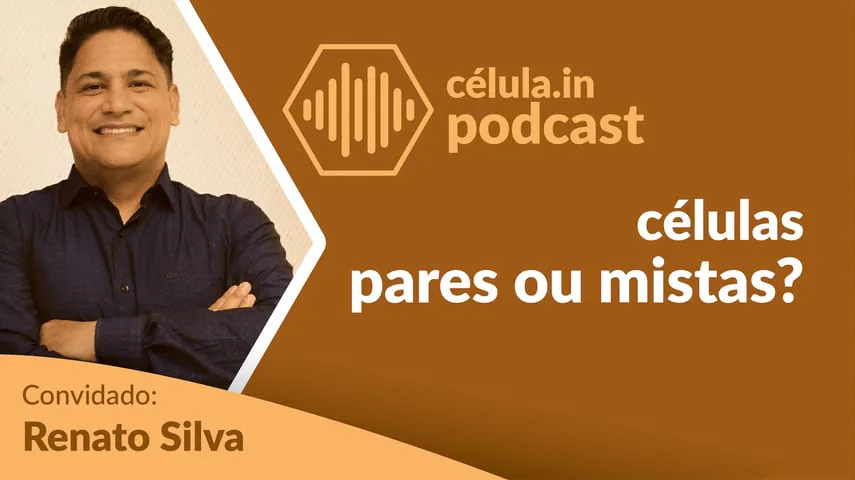
Presentation
Renato is the presiding pastor of the Cristo Vive National Baptist Church in Nova Serrana, Minas Gerais. In this episode we talked with Renato about small even and mixed groups.
We talked about organizational and supervisory characteristics of a church with only male small groups and women-only small groups. Renato told us about the experience of IBAN Cristo Vive about the migration of this structure to the small group model and supervision with men and women together, with the co-leadership of couples, sharing the difficulties and challenges, in addition to the actions they took to advance the change.
Summary
Splitting men and women into separate small groups creates a problem of its own: when a husband and a wife sit in different areas, any family matter turns into paperwork. That is what led Igreja Batista Nacional Cristo Vive, in Nova Serrana, to move to mixed groups led by couples, says lead pastor Renato Silva in this célula.in Podcast interview.
Today there are 71 groups. A couple leads together, a couple supervises together, and each area is led by a couple as well. Single adults, young people and teenagers remain separated by gender, and anyone who wants to keep a men-only or women-only group still can.
The change was not imposed and it was not smooth: part of the leadership refused it. He admits that in an earlier transition, from the conventional model to cell groups, he lost leaders because he was not prepared for it.
Before the second transition, he says he went after ecclesiology, doctrine, theology and reading on leadership, so he could decide with clarity. The gain he points to is practical: whatever needs solving is solved inside the group, the sector and the area themselves.
Listen to it at:
Listen to it at:

Tell us a little about how you became a pastor at Cristo Vive, and also how you came across the cell vision.
Our church here in the city has a number of congregations. There is a mother church that planted what we call the congregations, and that church sent me to plant a congregation in a neighborhood here in Nova Serrana called São Sebastião. We have been in that work ever since, and I served as a worker in the church until 2015, when my ordination came. We are a Baptist church within the national convention, and I became senior pastor of this particular community, and there are other Baptist churches in Nova Serrana.
We came across the cell vision in 2011. When I went to that neighborhood to organize the local community, I was always troubled by the membership, by members not being guided, not being shepherded. That bothered me a great deal, and I was looking for an answer to the problem: new converts not being followed up, and every task concentrated in me.
In 2011 I read The Purpose Driven Church, and there the author was talking about exactly that, about everything being concentrated in you. And I was the only pastor of this community, and to this day I am still the only pastor of this local community.
And how many members do you have today, and how many were there when this process started?
Today we have around 500, and we are working to improve how we track membership here. When we started into the cell vision, we averaged 80 members.
In 2011, besides The Purpose Driven Church, the model of the 12 also came along, which was very strong at that time, around 2009 and 2010. In 2011 we ran some discipleship classes inside the church building, but even so we knew that did not serve the purpose of growth, of multiplication, of evangelizing.
And that is when I came across Igreja Batista Central de Belo Horizonte, searching online. They were organizing a training session and I paid them a visit, and things really became much clearer to me.
Those discipleship classes we started in 2011 outgrew the building, and from then on we took that culture into homes. So in 2011 the first groups in homes appeared, and since then we have been living as a community: at the temple as a large group and in homes as small groups.
And how many small groups do you have today?
Today we have 71 small groups. We have had more than that, but we went through a period of about two years when the groups did not grow much. This year we managed to see where we can improve.
What did the structure of the small groups look like demographically? Was there a split by age, a men's group, a women's group, any mixed pairing? What was it like when you started and how did it change?
When we began, in 2011, and it stayed that way for some years, we started with men's and women's groups kept separate: within a group, it was either all men or all women.
With the young adults we started on Saturdays, and there we had young men and young women in the same meeting. But we could not keep that format: in early 2016, when the first teenagers appeared, we were keeping teenage boys in the same meeting as the girls, but seeing that they were somewhat caught up in the tensions of dating, we put the teenage boys on their own and the teenage girls on their own.
And the young adults stayed together from the start.
Then comes a transition. We realized that having a group of only men or only women stopped working well with the way we organize ourselves. The women depended on a ride from their husband and would wait a long time after the meeting, and that created some family friction. So we began transitioning so that men and women would be in the same meeting.
When you say meeting, you mean the weekly small group gatherings, correct?
That is right, the gatherings. We realized we could not keep that format because of the many conflicts that started to appear around transport and at the end of the meeting.
So we had to make that transition, and it was quite hard, because once you have an established way of organizing, changing it is complicated. We went through some very tiring moments, with people not accepting it, not agreeing. It took a lot of conversation with the leadership to carry that transition through.
We made the transition from a conventional church model to small groups and then, later, the same church had to go through another transition. And every transition has its challenges, we lived through that, but we came out the other side.
What was supervision like in the model you started with, were there problems, and how does it work now, in this arrangement with mixed cells?
Supervision, beyond any doubt, is one of the pillars of any small group church.
At the start, when we began having the first multiplications, we started assigning people to care for the leaders, but we had no good sense of how many leaders each supervisor could care for. So we ended up with people caring for ten or twelve leaders, and we saw that it did not work, because the supervisor could not stay close to the leader's life, he was overloaded.
Another thing that happened in the old format and did not work: a woman would be in the women's group, under the supervision of another woman, and if she had a marital conflict we had to go after the other supervisor, her husband's, who was in a different area. It took a whole mobilization to see whether we could handle that marital conflict.
And that is when we came across célula.in, on a recommendation from Igreja Batista Central de Belo Horizonte, in late 2015 or early 2016, with the possibility of tracking attendance better.
Then we began that transition, with men and women in the same group, and the supervisor could now have his wife alongside him caring for that leader, and the leader had his wife alongside him too. And that is good for us.
And we kept gaining knowledge about supervision, understanding that a supervisor needed the habit of getting into the system, of knowing how to read the numbers. We started tracking some indicators weekly and monthly: group attendance, usage. Later an even better version was released to us, and in the training sessions we went through with them which indicators mattered most, the ones that would help monitor the health of the group and point to something they could act on.
So today your supervision structure has a supervisor, and below that supervision are the cells, and within a cell there is a male or a female leader. Has that made the logistics of handling conflicts, marital ones for instance, simpler?
That is exactly it. Today a married adult leader normally has his wife with him leading the group, and a married supervisor has his wife alongside him. A married coordinator has his wife leading the area with him. So among couples it is always a shared leadership.
Single people and young adults are still separated into men and women. In the young adult group, for example, a man holds leadership over the group and so does a woman. And supervision for the young adults works the same way: there is a man and there is a woman.
And does everything in the cell meeting happen together? The refreshments, the worship, the teaching, the time of sharing, does all of that happen jointly between men and women, or is there a split at some point?
Most of our groups do it together. We leave the leader entirely free to make that call: if the leaders want the men sharing separately from the women, they have that autonomy. But most men and women take part in the sharing together, splitting up is rare.
There are groups where they split for the sharing and then come back together for the time of intercession, and the refreshments are shared together too. So the leadership has that autonomy, but most share with men and women together.
And does that apply to supervision as well, or is there a limit? For instance, do men not supervise women? How does that work?
When the wife is not there, we let the supervisor lead on his own, but in most cases, 98 or 99 percent, the wife is there taking part in that supervision alongside her husband.
When a couple is involved, it is always a couple. It is not a man who will be caring for a married woman. And there will always be a young woman leading the young women, in the case of young adults and teenagers.
There was a point where you saw in practice the need to make this change. But was it well received? Was it something the leaders wanted too, or was it more your own perception as a pastor?
That is a really good question, because think about it: the men in one house, the women in another house, and then come the conflicts, the challenges.
We needed a solution, and some accepted the proposal, but some would not accept it at all, because we had started that way, it had always been that way and they did not want to change under any circumstances: the men in one house and the women in another.
So it ran through 2016 and wrapped up at the very end of 2017, essentially. In 2016 we put men and women in the same group, and those two years were intense years of dialogue. There were conflicts, there was refusal, there were leaders saying they would not lead anymore, and us talking it through and showing the benefits. They were two very intense years of negotiating, explaining and persuading.
Did you end up with both formats coexisting: groups led by men with only men, groups led by women with only women, and also, for those who wanted it, the group led by a husband and wife?
Yes, we still organize that way today. If a leader wants a cell of only men, for instance, he has that cell of only men.
In some areas we have a group of only women. In an area with thirteen groups, we have one that is women only, and it comes under the care of a supervising couple, where the wife cares for her. And we have male ones too, where the married supervisor, the husband, cares for that male leader.
So we still have both, we understand it can be organized either way, but after our transition what prevails today are the groups with men and women together.
From the way you describe it, nothing was imposed. What was the biggest impact you noticed? And what led this to be more than an imposition, to bring all the leaders into it together?
In our first experience of transition, from the conventional model to the cell model, I realized I lacked wisdom. I believe pastors who have made that change from conventional to cell know how challenging it can be.
All those conflicts, I did not handle them well, and I believe that was down to my lack of wisdom in that first transition, where I lost leaders. It really was a lack of wisdom on my part.
So I understood that in this new transition I would have to be more careful, that I needed to keep command, in the good sense, seeking to clarify, to persuade, always to show the good side, the fruitful side, the good results those decisions would bring.
So I believe that was it. The first time, in 2011, when I made the transition, wisdom was lacking; and when I entered this second transition, in 2016 and 2017, I tried to be more patient, to persuade more. I focused on persuading, encouraging, talking things through, showing the benefits, showing how the problems would be solved, and getting through that period of nearly two years.
From 2016 to the very end of 2017, which you said was the main stretch of this change, what results did you see? Was the impact what you expected? Was the change worth it?
It was very much worth it, because, first, any kind of situation we need to resolve today, we resolve within the group, the sector and the area.
Let me give an example: a married woman was in one area, we had an area that was for women, and her husband was in another area, we had an area for men. It took a big mobilization to call everyone in, and that really was bureaucratic. And bureaucracy in an organization is terrible.
So with this transition, today everything is resolved in the group, or the sector, or the area. Why? Because the couple meets there, the family meets there, and the care is given by a leadership that is also a couple. So the ease of resolving the difficult situations that come up, the family situations, improved 100 percent.
So the expectations you had about problems being solved by this change were met?
They were. The purpose was to solve a particular problem, and we did solve that problem with this transition.
Was there a problem that would serve as a warning to a pastor going through something similar, with the same desire to make this transition? Something along the lines of watch out for this?
Yes. During that time, in 2016 and 2017, I realized I needed a deeper ecclesiology, I needed to draw closer to the doctrine of the church. So I really applied myself to that, because I was going into a new transition, and the transitions were necessary, but I needed to be better prepared, I needed to be in touch with the church's compass, with confidence and clarity. And prayer, because prayer really works.
And I realized that one of the things I would need, as leader of the community, was to go deeper into the doctrine of the church. Second, into the mission of the church. Theology was another subject I had to go deeper into. And leadership, so I could make decisions without fear, with confidence.
I realized that the knowledge I had of the cell vision was still very shallow, I needed to go deeper. So that challenge led me to deepen my knowledge in that area.
That would be our great tip, the experience we can pass on to every leader: you need to go deep in theology, in ecclesiology, in leadership, in organization, so you can be secure in the decisions you make. They look like simple decisions, but they are important.
I was afraid: what if this decision of mine is wrong, what will happen to us? And you fill up with fear, my God, what if I make the wrong decision? That really drove me to seek out knowledge.
And which books do you recommend, the ones that mattered most to you in this process?
The Second Reformation, about reforming the ministry structure, was the first book I read. Sinais Vitais do Grupo Pequeno was important too. The Master Plan of Evangelism also mattered a great deal to me. O Bastão da Liderança, published by Esperança, and Treinando Obreiros, also from Esperança. Unidades Básicas do Corpo de Cristo, on cell ministry, as well.
I recommend The Second Reformation, that one helped me enormously, and the older ones too, like The Master Plan of Evangelism. And Courageous Leadership is another book that mattered to me regarding where my leadership stands and how to improve it, and it was very important for making some decisions, when we get afraid of making decisions.
 Facebook
 WhatsApp