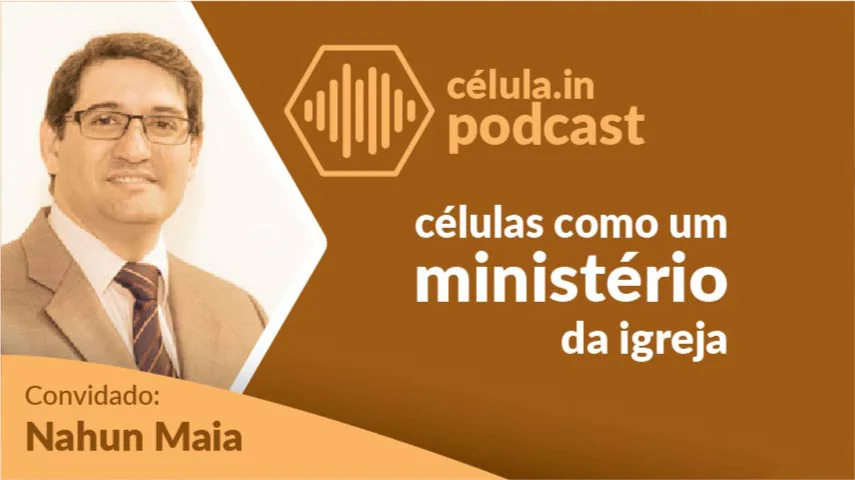
Nahum, how was the process of implementing the small group ministry in the Fortaleza GDP?
We are a church that is almost 88 years old and in this historical process we have experienced many models of church management.
In 1996, the first small-group model arrived for us. The initial idea was to generate communion in the church.
In 1999, the church began to take a more careful look at small groups. At the time he was another pastor who was helping.
He was responsible for coordinating these groups. The coordination, basically, was to insert people into small groups and to take appropriate precautions so that there would then be no possible divisions in the church.
We had nothing to do with the G12, but it was at a time when the vision of the G12 was effervescent. Anyway, the concern of the church leadership at that time was that there was no split.
How many members did the church have at that time?
This issue of membership in our church is very interesting. It's around 1,200, 1,400, 1,600, soon 1200, 1400.
There is a constant influx and departure of members due to the fact that many people come to work in Fortaleza, many soldiers, many outsiders, and it turns out that we are a reference because we live in a neighborhood that is highly sought after by outsiders.
So, at that time there were around 1200 members and today we are around 1,800 members.
But that growth didn't come from small groups because until last year that wasn't the focus of small groups.
Yeah, and what changed here last year?
Until last year our focus was on communion, and this year we decided to walk with the National Missions Board, with small multiplier groups.
The focus is on the multiplication of small groups, on evangelism, on bringing new people to the church through small groups.
But that's not going to change the current structure of the small group ministry. We will continue to have the ministry in the church.
Let's not touch the small traditional groups, which have existed for at least 20 years, they can continue to generate communion and be that small group as it always was.
However, we will encourage and motivate the church to truly become a multiplier church based on small groups.
What motivated them to be a church that multiplies small groups?
We have seen the movement take place in many churches, all over Brazil, churches have grown. And we understand that the time has come for us to start implementing this methodology within our church.
In a previous, administrative conversation with our presiding pastor, he has no intention of changing the concept of a church with small groups to be a church in small groups.
The idea is to continue with the small groups, however, with now with that evangelistic footprint within them.
What is the primary difference between the formation of leaders in the small group model of communion and now with this vision of multiplication?
Until last year, in the training we gave to our leaders, we were already talking about evangelism, about discipleship, but that was not the emphasis.
This year we are rescuing an old seminary called Contagious Christian. We want to pass on this vision to the church that we must be contagious Christians yes!
Leaders need to be contagious, and they need to be ready to disciple, even within their small groups.
The idea is that as people are converted into small groups, the leader himself can now disciple another one.
Then they'll be receiving infectious Christian training and we're redesigning the church's overall leadership training.
And how is it for you, Nahum, to deal with small groups as another church ministry.
As a process manager, I confess that it was a great challenge.
You need to generate communion, generate connection and soon you have to tell the leader: “Dude, multiply the group”.
Then he says: “Pastor, but how? Now that I've learned to love my brother and take care of him? Are you joking? Do I have to multiply my group?”
I have great challenges in this area.
What are they doing so that there are no fights and divisions in the church once the cell groups are more prominent?
Today we have mature leadership. We lived in small groups over many years.
The backbone of leader training is what we think and what we want as a church.
To be a fruitful church I need to have healthy groups that result in transformed lives, that result in mature lives, so that they can generate new groups.
The multiplication will happen now, regardless of what it may be, it must be mature, with mature leaders.
Our church values are based on PESCAI: Proclamation; Building; Service; Communion; Worship, and Intersection.
And those who go fishing need bait, so our ISCA means: Integrate; Serve, Grow and Achieve.
We achieved this the last 7 years, today we have mature leadership, we have a church that understood the need to be participating in a small group and with that we now have the peace of mind to start taking the first steps to be that multiplier church.
Today we have much more peace of mind than we had a few years ago, today we have created a church format where we feel safe.
We use the célula.in app. He helps us like hell! It helps to better understand our leader, his needs, where he is, why he is. We may share other data that shows us the reality.
Today we have information that we didn't have before.
So, it's a set of tools, ideas, and people that today makes us no longer afraid of the breakup of the church.
What are the points that are still a source of headache for you?
The fact that we're a ministry.
The person is involved in other activities in the church, in other ministries. She is part of the small group ministry when he is in small group.
But in truth, he may be the leader of the social action ministry, the leader of missions, mission trips...
Then I want, for example, to schedule training. I can't, because most of the cell group leaders and participants went on the trip.
So we need to have this flexibility at church so that people give due importance to the small group. In the sense that it is truly a stepping stone in the church's growth process, of maturation.
Fortaleza's PIB is a welcoming church. How do you take care of people?
This care is the idea of the traditional model. Today, before this interview, I already made two hospital visits. Care is still very much on the pastor.
But then it doesn't overwhelm?
Of course it's overwhelming! As the other one says, we turn around in our 30s.
Today I have the advisors. I elected some people here at the church, not because of the growth of the small group, I simply elected people here at the church who have a shepherding and caring profile, and I asked them to work with me within the ministry.
They help me take care of those other small group leaders. They meet at least every couple of months to talk, “Dude how are things? Are you all right? Is family okay?” , in a more personal, closer conversation.
Would you advise a pastor to have a church with small group ministry or a cell-based church?
Before that, the pastor must focus on two points:
1. Analyze what you want as a church.
2. Find out which of these church growth models appeal to you.
I'm going to work with the MDA people, I'm going to work with the IBCBH people, I'm going to work with the cell group people from Paraná, I'm going to pick it up outside Brazil.
It is necessary to seek wisdom from God himself to know where you are going to start.
That said, the advice I give is to start a cell-based church.
I wouldn't exactly take a model from a church and apply it. We would make the necessary considerations and find our way of living in cell groups.
What Jesus left us was: so go and make disciples.
Over the years, Billy Graham was a firm believer that making disciples was filling up a stadium and preaching to crowds.
Paulo Solonca, who was pastor for many years in Floripa's GDP, made disciples walk with the person.
Paulo Mazoni already has another vision of the process. God gave Abe Huber another model of church.
My advice, really: You don't turn on the model, you turn on the modeler.
He looks at Jesus and says: “Lord, what do you have for me?

 Facebook
 WhatsApp