Presentation
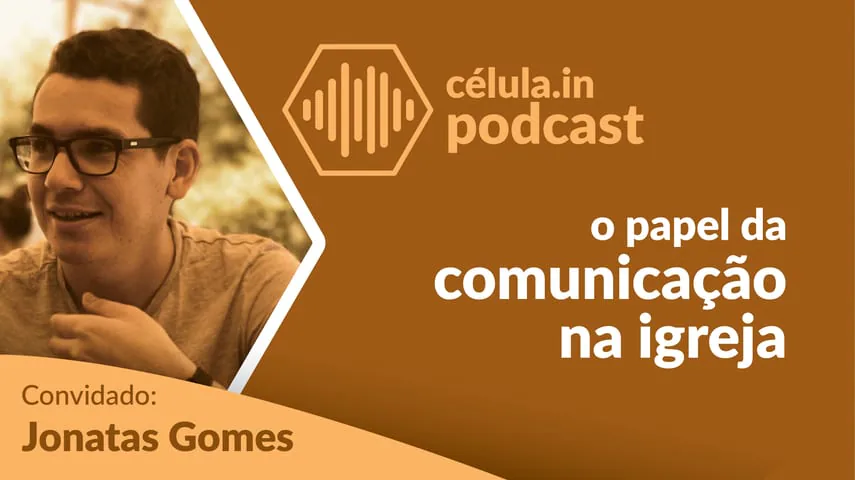
Jonatas is an adjunct pastor at the Leiria Baptist Church, in Portugal, where he is also responsible for the church's cell groups and communication areas.
Jonatas also has a degree in communication and media. In this episode we chatted with Jonatas about communication.
We talked about what communication is and what is the role of communication for churches. Jonatas alerts us to the importance of understanding the context in which the church is inserted before outlining the objectives and strategies necessary for successful communication.
Summary
Church communication starts before social media: it starts with the mission. Until a church can say what it is and who it exists for, it has nothing to communicate. That is the position of Jonatas, associate pastor at Igreja Batista de Leiria in Portugal, where he leads both the cell group and the communication areas, and a graduate in communication and media, in this célula.in Podcast interview.
Once the mission is settled, he separates two audiences. The internal one, of members and leaders, needs information and devotional content. The external one, of people who do not attend yet, needs its own language and material. Speaking to both in the same way is the most common mistake.
Without a digital presence, he says, a church is invisible to anyone looking for it: in Portugal, of some 70 Baptist churches, only about ten have a website. And being on social media is not enough, it takes regularity, a calendar of subjects and content shaped for each platform.
The bottleneck, in his experience, is people. His way out is to find the gifts already inside the church and invest in training the younger members, instead of waiting for a trained professional, and for a pastor who is not good at this to hand it to someone who is.
Listen to it at:
Listen to it at:

What is communication? And beyond that, what is communication applied to a church setting?
We live this great challenge here in the European context, and communication really has become the church's great challenge today.
I like to look at communication as this idea of sharing. And when we consider communication, people sometimes ask where it came from, whether it comes from recent theorists, where it started. And it is fascinating, because when we look at the Word of God we see that Jesus was, and still is, one of the greatest communicators of all time.
It is interesting to think about the craft of communication in a context like his, in New Testament times, when there was no complex technology: they truly became masters of the spoken and the written word.
Communication is closely tied to grasping what my mission is. It connects to interpersonal communication, which also runs through dialogue and interaction with people, with the crowd and so on. And it is striking to see that in Jesus, because he was fully aware of his mission on earth. Then came the great challenge: how do you carry it out? That is where the ability to hold a conversation, to understand others, to make yourself understood comes in. Jesus was truly accomplished at that.
I believe the church needs to learn from Jesus and from the leaders in the Bible, who also left us beautiful examples, like Moses and David, of how to communicate, how to hold a conversation. And perhaps that is the great challenge for the church in the 21st century, because we live in a time when communication is everywhere and we are bombarded with information. So the church also needs to be part of that. A church without communication, I would say, would be an invisible church.
We really do need to do our utmost to communicate this message, this good news, in a current way, so it reaches a great many people. I think that if Jesus were in our time, he would use every tool available and necessary to communicate the good news.
If communication is a challenge, it needs intent, a chosen direction, so the process turns out the way you want. In that sense, how important is it to work on this inside the church?
Without a doubt, a communication strategy is essential, above all because we are thinking about people, and we have to think about what it is we intend to communicate.
When we talk about communication inside the church, looking at it contextually, we are talking about an internal audience and an external one. The internal audience is everyone who is part of our community: the members, the congregation, the church leaders, the people who need communication to be well aligned so things can work.
The external audience is the people who do not belong to the Christian community, people who may not yet hold our beliefs and whose values are different from ours. Getting the message across to them in a way that catches their attention, that draws them in, is the great challenge.
For instance, when we think about personas we are thinking about different audiences and different people: from a child to a teenager, to a young couple, to older people, people at particular moments in life who have different needs when it comes to content and to communication itself.
That is why it matters so much to define that strategy well, for the church to grasp that it needs to communicate inward but also outward. And that becomes a real challenge, because I have to work in context. In Portugal, for example, seven out of every ten marriages end in divorce. Data like that signals an urgent need to address the family as a theme: how to work on it internally, for the church, and how to work on it externally, through campaigns and other means. It is genuinely a great contextual challenge.
You mentioned that Jesus was the greatest communicator, that he knew exactly what his mission and purpose were, and that is why he communicated so well. Should I take it, then, that the first step toward good communication is for the church to be very clear about its mission, its role within the community where it sits?
Without a doubt. We see that this may be the church's great challenge: understanding its mission and its vision. I remember that when we began the transition to a cell church, we had to look at Jesus, look at what he truly wanted from us. And once the church grasped that well, it made us able to take another step forward.
I believe the mission and the vision are always the same: to reach people with the gospel, to make disciples of all nations. We even reworked our mission and vision. I remember that during that process we invited the church leadership in to talk it through.
Our church, Igreja Batista de Leiria, is a century old church, founded in 1916, in the Fátima region, a few kilometers from Fátima, and that is a considerable challenge, because it stands in front of the second largest center of Catholicism in the world. For 100 years there was a great deal of persecution, and through it several evangelical churches were also founded in the region.
But a moment comes when we need to look to the future, to the church's next 100 years. That is when we really thought about the new mission, understanding this call of Jesus: every member a disciple and every disciple a disciple maker. And our vision is to be a church that is relevant to society, that looks to those outside while also caring for those inside the church.
And through that mission and vision, which came from Jesus himself, everything in our life becomes easier, because what we are going to communicate depends precisely on what we understand our mission and vision to be. Jesus had that brief very clear. Jesus knew what he was meant to do. He took his disciples and said: this is the way. And from there the disciples showed all of humanity that Jesus was the Savior.
The sociocultural context changes, and the church in Leiria itself has been through completely different scenarios since the early 20th century. What worked a few years ago may simply not work today. How does that play out in practice? How do you assess what is working and what is not?
I think we are living through a shift in paradigms. When we talk about media, we are also talking about a divide between traditional media and digital media. Before, communication was centralized in television and in printed newspapers, and in a way the church's strategy was an evangelism strategy built on word of mouth, on personal testimony.
This new digital environment we are part of today has become the main tool for communicating with people, from the youngest to the oldest. For a church to be socially relevant today, it also needs a digital presence.
And when we talk about reaching people, that is exactly it: sometimes the church is not even that large, but without a digital presence today, people will not find their way there. Take the European context, where we receive many immigrants: where does someone search today? Not in the newspapers, not in traditional media or on television, not least because they would not have the money to advertise there. They will look on social media, on a website that actually works. All of that reflects a major shift the church needs to adjust to.
What is interesting is that each approach calls for different content. When we deal with events, service times, ministry meetings, the church's general calendar, we are working with informational content. When we cover services, events, broadcasts, in video, audio, text or photo, whatever it may be, we are working in a more interactive way.
And even for church members, for the internal audience, where I want to work with biblical texts, verses, prayer requests, I do that in a more devotional register. Then there is the evangelistic side: to reach people today I need to produce content aimed at those who do not know Jesus, and communicate it differently from the way I communicate inward, because inside the church I sometimes want a more doctrinal angle, and at times that is needed. But the content really is different.
And the way we assess whether our communication is well done, well crafted, is part of the vision too. Far be it from me to compare the church to a company, but there are tools today we can use to analyze and make a strategic diagnosis of the church and set future objectives. With a SWOT analysis, for instance, I can see the church's strengths, its weaknesses, its threats and its opportunities.
When we went through that restructuring process, when we put a project together, we analyzed all of it: what the church's strengths were, the credibility that comes from its history, a well organized structure. And we started to see a series of other factors, weaknesses and threats, that could be turned into great opportunities to grow. That made a real difference.
In our episode 9 we talked about social media, and the guest commented that if the people in your church are disconnected on social media, they are probably disconnected from the church, from the body, as well. Does that hold up, given that being on social media today is an intentional way of communicating with people?
Without a doubt. I think Ronis's position is very interesting, the church needs to be where people are. We reckon that sixty to seventy percent of the people in our churches are on social media. And more than that, it is also where the people we want to reach are. That is the basis on which we go looking for them where they already are.
For example, when we plan today at the level of ministries, worship, communication, inviting people, sending messages, we do it through social media and messaging: WhatsApp, Facebook. And one tool increasingly used in that dimension, in the images, in what the church produces, is the idea of telling stories, storytelling, as a way of strengthening the vision of what the church has been.
I have talked with many pastors today, from other denominations in Portugal as well, and unfortunately one thing we have noticed is that European churches have not yet woken up to the importance of a digital presence. Out of 70 Baptist churches in the country, we probably have about 10 with websites. And with a real presence on social media, fewer still.
And we can perhaps diagnose a problem here, which is the shortage of contributors, of volunteers, whether in marketing, in communication or in design. That plays a fundamental role: if we have people like that inside our churches, our work in communication will certainly be much easier.
But it takes more than having that digital presence: publishing regularly matters too. Being present on any digital platform is important, and it is important to publish differently, taking into account the medium being used. I believe that managing this properly makes interaction with the audience far more likely. In the same way, it is crucial to set the calendar of themes as well as the timing. All of that helps.
In your experience, do pastors see this area as requiring professional work, meaning it is not enough for just anyone to open an Instagram account and start posting? Or is it seen as something we should have, but without spending much energy on it?
Unfortunately I think it leans toward the second. And I think it is not so much a question of whether they see it as deserving better investment, but rather that the vision has not been properly worked through. Churches publish images, texts and so on without using them in a more considered way, and that ends up projecting an amateur image of who we are.
So we sit between two problems: working with amateurism, with people who want to do it but do not know how, and people who do know how but have other priorities and would rather not do it for the church.
That is where the challenge comes in for the church leader, the pastor, the communication area: identifying the gifts and the people with an aptitude for this, and structuring something like a communication department. If the church has no one trained in marketing or design today, why not invest in the university education of a young person, or several, who could work in that area?
I remember that when I came to Portugal, three years ago now, one of the things I realized would be extremely important for settling into the European context was to enroll at university. And I asked myself: which course should I take? I began to see that the future of the church runs through communicating well in this context. That is when God gave me the opportunity to enroll in communication and media and try to bring the necessary tools to the church.
The church was my laboratory: throughout my course, everything I set out to do had to do with the gospel, had to do with the church. My heart is in the church, and that made it much easier to create a website strategy and a communication project for the church.
And it is interesting because people were surprised to see someone trying to tie communication tools to a church context, because even in the Catholic context, which is predominant here, there is still not much investment in this area. In fact, my professor was responsible for the communication of the cathedral of Fátima for a long time, and he used to say there was a need, because the church had no communication plan.
Today churches, the Catholic church included, have woken up to the importance of communication, and now we have television and a great deal of investment in social media as well. But the evangelical church, the Baptist church and other denominations increasingly need to invest in this area if they want to grow and reach more people.
You created a communication manual for the church in Leiria as your final course project. How was it received by the other pastors and by the church in general? And has it been put into practice?
I have the advantage of being one of the church's pastors, which helped. But the project, the proposal for a communication manual, was created to solve the church's needs in communication, both internal and external. We realized we needed to bring in new technologies and get people comfortable with them, but in a more systematic way as well.
And when I took it to the senior pastor of the church, pastor António Gonçalves, and to the rest of the leadership, it was a challenge, because we ran a deep analysis of where our failures were and what we could get right. It was a very important moment.
We saw that, at a time when the internet holds an ever more privileged place in how people get information, a strong and strategic online presence had become essential for the church's communication. That is the sense in which this project, this manual, became relevant: the church needed a well developed communication strategy and even a service capable of answering people's needs.
For example, the brothers and sisters in the church, the people within the community itself, always raise this point: we need a newsletter, we need to know what is going on. And then we also have to reach the people outside.
I remember one of my professors ran some questionnaires and said: the great strength of this project is that it will be a very practical one, one you will actually be able to use in your own reality. And that is exactly what happened: we drew up a schedule to implement the project across 2018.
Some things are proving easier to implement, others take longer, because we need people we do not have yet. We do not need top professionals, but we do need to give the church's communication volunteers at least a basic level of training.
And there are churches today doing this very well. One of my reference points in this area is probably Hillsong, a church that is here in Portugal and is also spreading around the world. Their communication volunteer department is very well structured, across several areas.
Church communicators really do need to be people willing to contribute to the advance of the message. Consider this: putting together a church newsletter may be fairly simple, but when we talk about live broadcasts, weekly videos, promotional pieces, campaigns, the layout of materials and graphic assets, that does demand quality in the tools we have, starting with cameras, and it demands investment and vision from the church.
Because sometimes the pastor has the vision but not the resources to invest in that area. And the reverse happens too: often the church does have the money but prefers to invest elsewhere and gives this less importance. That can have consequences, because when we invest in communication it is an investment that will bear fruit, whether in the short, medium or long term. But the leadership's vision has to be well aligned on all of this.
So it was easier to implement this vision in our church because we had many people connected to communication. The church already had a presence in the city's traditional newspapers, but it did not yet have a well built institutional website, it did not yet have a strong digital presence.
So we are working to get this project off the page and implemented in every area we can: from the newsletters and the online broadcasts to the new promotional pieces and campaigns.
Igreja Batista de Leiria is a century old church. Did you have any difficulty getting this message across, the importance of being present in digital media, given that context?
I think an essential trait for the growth of a leader, of a pastor, is humility: the humility to admit when he does not master a given subject, when he is not good in an area, but has people who will do it far better than he would, and so bring about greater growth for the church.
That was exactly our reality here: our pastor realized it was not an area he mastered, but he gave the department, the communication area, complete freedom to invest and find its way. That is why it matters for a pastor to have that vision of delegating, that vision of sharing.
In a century old church, a traditional church, making those changes in communication was genuinely important, and it is also a process of showing the church why it matters. And that is where our resources come in, starting with leadership training.
I think sometimes we do not need the whole church to take up the project right at the start, but little by little the church sees that it makes a difference. There is no church where people dislike having good communication in the service, good image projection, good videos, testimonies, going on social media and being constantly informed about what is happening, receiving newsletters with the images and the information, everything well aligned. The church begins to feel the difference, the change.
And we felt that here in the church: when we started communicating and investing better in what we want to say to people, they even took more pleasure in investing in the church itself, because they were getting feedback, they were getting a visible response to what had not been communicated before. And that makes all the difference.
So if the pastor is not good at communication, if he does not even have Facebook or Instagram, look for people who can help with that, look for people who can fill that role, and invest in those people, because it will mean growth for his own ministry.
Any final advice for listeners who want to lift the level of communication in their churches?
In moments like this we want to have a ready made answer, but I think what matters is for the church to build its communication department well and to invest in people, especially in this younger generation, which is a highly connected one.
I still remember a teenager at our church, around 12 years old, and I never imagined he had a gift for communication. Recently, two weeks ago, I saw a video of his on YouTube with almost 5,000 views, and I thought: how did I not see this before? So the people are there, we just need to find them and invest in them.
We also need to look at the churches that set the standard: find out who is doing it well and, within our own limits, adapt it to our context. So whether your church has 30, 40, 50 members or ten thousand, always try to adapt to your own reality what others are doing with excellence. Because at first it may not come out very polished, but little by little it gains excellent quality and grows too.
So there is the challenge for church leaders and members. To the leaders, may they have the vision to invest in communication. And to those who are led and have an aptitude in communication, marketing or design, may they put themselves at the church's disposal to serve the Kingdom of God in this. I think that is fundamental, it will lead to growth and, without a doubt, we will fulfill our mission and proclaim Jesus.
 Facebook
 WhatsApp