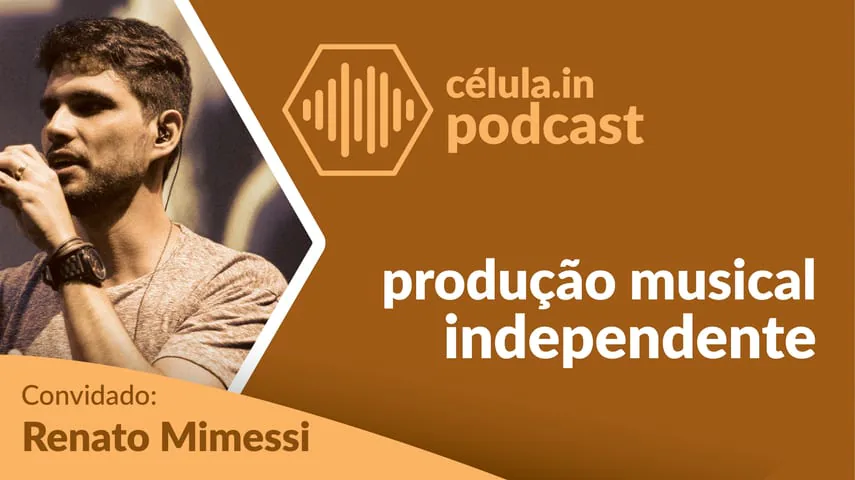
Presentation
Renato is a musician, cell group leader, area coordinator and responsible for youth worship at the Central Baptist Church of Belo Horizonte, in the Luxemburg unit.
In this episode we talked about the main characteristics of an independent musical production.
Renato shared with us part of his experience in the design and execution of the project that originated the album Porta Estreita, released in 2016.
Summary
An independent album is one the artist directs and pays for: they hire the producer, choose the musicians and have the final say on every arrangement. That is how Renato, a musician who leads youth worship at Igreja Batista Central de Belo Horizonte, describes making the album Porta Estreita in this célula.in Podcast interview.
The path has fixed stages: pre-production, with the songs recorded as voice and guitar against a metronome and the arrangements approved one by one; recording, usually one instrument at a time; and finally mixing and mastering.
The main obstacle is money. Every stage has its own price, and projects that stall for lack of funds are common, sometimes for years. Hiring a producer and a studio that handle recording, mixing and mastering together brings the cost down.
As for promotion, the physical CD is no longer a requirement: YouTube gives visibility and the platforms host the work, but streaming only pays off at a high volume of plays. In his case, CD sales covered the bill. His closing advice is to be bold and to ask for honest feedback, because most of what you write will not be used.
Listen to it at:
Listen to it at:

Tell us a little about how you got involved with music. How far back does that go? Did it start in a church setting?
My ministry life started when I was around 15. I taught myself guitar and began playing at church.
Singing came a bit later, around 19, when I started taking the risk of singing and writing a few songs. I really began leading worship at about 20, at Igreja do Porto, in Porto Velho. I got involved with the ministry there and wrote some material.
In the meantime I was in law school. I put my degree on hold a year and a half in to attend the discipleship training school at Jocum, that was 2003, 2004.
After that I went to Australia, to the leadership school at Hillsong College, focused on worship. It was great, it really widened my view. That was 2009.
Then, in 2011, I was invited to move to Belo Horizonte to work at the state legislature as an aide to a representative.
Was that move to Belo Horizonte a job offer?
It was work. Actually, I had started dating Paula in 2009, to be exact, and we spent a while in a long distance relationship. Then this offer came and I decided to move here.
In that first year they were looking for songs to record the church's first album, Sem Paredes, and I contributed two songs. Later, in 2015, I had two songs on Majestoso. In 2016 I released my own solo album, my first project.
You spent time in Australia, at Hillsong College, and you said it really widened your view of worship. What had the biggest impact on you? What was the turning point?
There are the classes, extremely talented people, and your references right there next to you, people I had followed for years, whose fan I really was. They were all there, but that is not what actually taught me, what opened my mind.
What is interesting is that you learn a lot from the people themselves, from living alongside them, from church life, from being involved in the work of the church. So my mind opened up, especially about what a church can be.
Hillsong has always been a very organized church, excellent at everything it does, always pursuing new ground. They take certain pioneering steps every 20 or 30 years that are quite interesting in themselves.
It is a church that wants to stay ahead, at the front edge, and that pushes you to think outside the box whether you like it or not. That is great, because I came away, not with some absolute truth, but with a wider sense of what a healthy church looks like.
In Brazil, for a long time, and I include myself here, we have leaned very heavily on "God will provide". They are a great example of organization and excellence, and our churches, not so much. I found that very striking.
At the same time, Brazilians have always been deeply spiritual, we long for the supernatural of God and we live it. So what the trip gave me was a stronger sense of how much management, institutional organization and planning matter, and at the same time how much the spiritual life, the supernatural of God, matters in the church. Walking within those two pillars, which I think are essential to a healthy church.
In terms of worship, you learn to think outside the box, you step out of your bubble a little, and that adds a lot to our ministry role as worship leaders.
For someone who knows nothing about music, what does thinking outside the bubble mean in practice? What is the prevailing Brazilian view in churches today, and how can that outside thinking be applied day to day?
The way I see it, we have a somewhat conservative culture, excessively conservative. I can at least speak for myself: for a long time I was afraid of anything new, I always leaned on what I knew was safe. And when you are locked into one paradigm, you stop exploring new possibilities.
When you are in an environment like Hillsong, where they are constantly trying to be at the front edge, pioneering, proposing and creating new things, that challenges your paradigm and makes you think beyond what feels too safe to us. It stimulates our creativity, and that is great.
For anyone who wants to live through an experience like that, it is well worth it, and I would recommend it to anyone involved in worship ministry.
Since you lead youth worship at the Luxemburgo campus, has any of that culture you absorbed been put into practice? Has your influence had an effect there?
I would like to believe so. I can say that, ever since I arrived, I have talked a lot with the leadership. I am not the church's overall worship pastor, but I have always had contact and a close relationship with Beth, and more recently Johny joined the church staff. I have always talked things through and shared my experience.
I believe I made a small contribution to some changes in management, in scheduling. They used to work with a fixed band, and I said: let us move to a rotation.
I think I started to have a little more influence two or three years ago, when we had more freedom to build an identity within the youth context at Luxemburgo. And in a way Luxemburgo is a reference for the other campuses. The intention is for it to be a reference point, so I believe it has shaped the church's worship identity somewhat.
For a while now there has been a consistency to the worship: you no longer get the feeling that one band is good and another is not. What changed?
I think that change of system has a lot to do with it, because the church used to work with a fixed band. And when you work with a fixed band, each band develops its own identity, that is the natural tendency. People build their relationship, their chemistry. On one hand that is very good, the chemistry within the band, but you lose a unified identity across the church, across the worship ministry as a whole.
So one of the goals in moving to a rotation is exactly that: every time you lead, you lead alongside someone different, a bass player, a guitarist. There is no fixed band, people are scheduled individually.
And here is what that produces: everyone has to learn the church's shared repertoire, which everyone has access to, so everyone learns the same arrangements, the same songs available there. When we want to bring in a new song there is even a bit of bureaucracy, because it cannot be last minute, it has to be approved.
So things are more unified, people are always leading with different people, and that creates unity, identity, repertoire. That is the intention. It is a fairly slow process to reach the ideal, but it works.
Your path as a musician ran alongside your path within the church. Was there ever a point where those two diverged? Did you play in a band outside the church context?
I went through a really bad stretch in my life. I was starting college and I spent a period away from God, away from church. It was a fragile time, my family was changing churches, a number of things. My friends called me and I went along with it. I was away for a while, I had a rock band.
It did not last long, thank God, but I still feel the weight of that lost time, and now and then I preach about it. I always think: I believe I am two years behind where I could have been. Two years away from God, and I think about what God could have built in my life during those two lost years.
And musically, was that time away a waste, or did you gain anything from it?
Looking back today, I do not think I got anything out of it. First because it was a cover band, so we were always tied to a template, we did not create, we only copied. And second because I played bass. I took a shot at bass back then, it was fine, but it did not carry over to what I do today.
Maybe in terms of a critical ear, of music production, of musical skill, I may have developed something, I am not sure. It may have had some influence, but nothing significant I could point to.
Do you work full time in music today?
No, I do not make my living from music. I am still a lawyer and I practice law. I no longer work at the state legislature, I am at the audit court now, as an adviser to a board member. So I work Monday to Friday and give my weekends to the church and its commitments.
But is that something you would want?
I do want it. Not exactly to live full time from music, but I have a shepherd's heart, and I would like that. I have been enjoying it a lot, I am coordinating an area, I started recently, but I have enjoyed it.
It is in my heart, but I am waiting to see God's direction, to see what happens.
In 2016 you released an album entirely your own, Porta Estreita. What does that production process look like? Is it fully independent? Is there any backing behind it, financial or otherwise?
As I mentioned, I was already writing before I moved here, I had some songs, I sang at my local church. But after moving to Belo Horizonte I basically started my life over.
So I could not arrive and immediately record something that would go anywhere, because nobody knew me, nobody had really seen me. How would I release something in a place where no one knows me? So I handed it to God and said: God, in your time, if it is your will, and in your way.
I came here in 2011 and, five years later, having been part of Sem Paredes and Majestoso, God put it on my heart. I went back to writing with this project in view, and the songs came: older songs I had never finished, some ideas I completed here. I chose Tremenda Graça as the album's anchor song.
From there, once the repertoire is set, you need to go find a producer. I had no label behind me, it was fully independent, no company backed me financially. The only financial support came from my parents, who have always encouraged and supported me.
So I went into the studio and we recorded my songs with just voice and guitar, to a metronome, which establishes the tempo of each song right at the start.
After that the producer, in this case Márcio Melo, who is now music director at the church, takes the songs and starts working on the arrangements.
Is the arrangement everything that is not your voice?
The arrangement is all the instrumentation: drums, bass, guitar, keys, piano, the whole accompaniment. So the producer works on the arrangements and we approve them song by song. That is pre production.
Once we approve, we go into the studio and start recording. There is usually a sequence that starts with drums, then bass, then the other instruments, guitar, then vocals. Each of those instruments is recorded separately.
For a layperson: does each musician record their part separately? Is there such a thing as recording the song live, or is it always individual?
Normally, in a studio production, you start with drums, then record bass, then vocals.
There is also the option of recording every instrument at once. That can be done live, during a service on the church stage, or in a live session, which people have been doing a lot: everyone together in the studio, filming a video, recording there.
Even then, each instrument is captured on its own channel. So even when everything is played at once, each part is captured individually, so it can be edited or re recorded if needed.
With Porta Estreita it was in the studio, recorded separately. Two days recording only drums, one day recording only bass, building it up that way.
How long does that whole process take, pre production and recording?
It varies a lot, it depends on a number of factors. The creative process takes a while, and it also depends on how many tracks there are, a project with fourteen or fifteen tracks. Those factors determine how long it will take.
Another thing that affects the timeline is the ability of the musicians on the recording. If they are professionals, used to recording, it is different, because there is a difference between a studio musician and a live musician. It really is a different feel.
So with professionals it goes very fast. When you use people from the church, who are not used to recording, there is a bit more work involved.
And the creative process, conceiving the arrangements, takes a while because of the approval cycle. After I play the song with voice and guitar and we set the tempo, a lot of information still has to flow: he asks what I am thinking, and I give him a sense of it, I play him some songs, some artists, maybe some projects as references.
It is an exchange with the producer, so he knows what you are after, what the identity of the project is. Once you get there, he works on that specific track. Then he sends you a first concept, you approve it or change something, and it goes on from there.
Are the instrumentalists chosen by the producer, or do you sometimes have someone in mind already? How does that choice work?
That is one of the differences between an independent project and a dependent one. When you are tied to a production company, you are hostage to a series of impositions: you will record with this musician. On an independent project we have total freedom to choose who plays. You hire a producer, but you are the director of the project.
Director in the sense that the final calls, actually approving something or not, are mine. I am the one who approves: this one is good, let us do this line this way. But the person who oversees the technical side, who says whether a take is good, whether that recorded passage worked, that is the producer.
On an independent project you have that freedom, and you have the independence too. Otherwise it depends on your relationship with the production company, on all those factors.
What were the biggest difficulties you faced producing Porta Estreita?
I think the biggest difficulty, usually in productions like this, is the financial side, because every stage has a cost. Hiring the producer is a cost, booking the studio is another cost, there is tracking, there is mixing, there is mastering.
That is why some projects out there sit still for a while: someone starts, gets stuck, runs out of money to fund the project and pauses. I have heard of projects that took two years to finish.
In my case I hired Márcio as the producer and recorded at Sarah Stúdio, in Contagem, together with Régis, who owns the studio and is also a music producer. They worked together from tracking through mastering, with Márcio focused on the mixing.
So I managed to cover all those stages with few people, because not everyone does all three: tracking, mixing and mastering. Like it or not, that brings the cost down a bit. And thank God I never got to the point of having to stop the project.
Once the music production ends, does promotion begin, or does that start earlier? Does anyone else join the small team to handle promotion?
While I was in the studio recording, we already have social media today, which promotes in real time, so I shared a lot of it during the recording, through Instagram.
But at a certain point I had to stop and work on the album art, on the visual identity and so on. That is when another character enters the story, the designer.
Is the physical CD still a thing? In independent productions today, does pressing a CD still matter?
We are going through a media transition, the same way we went through the cassette transition, vinyl, then VHS to DVD and Blu-ray. Today we are moving from physical media to digital.
These days you see people who have promoted their work and reached a wide audience without a CD, working only with digital media. The CD is no longer a requirement. In the past, if you did not press a project, you were not considered someone with a project. Now, not pressing a CD does not mean you do not have one.
Is streaming distribution part of the promotion plan?
What people have been doing is using YouTube heavily to promote the project, and Spotify and the other platforms to host it. So you use image combined with audio, which is what YouTube offers, to do the promotion.
You record a live session, you record a video, you put it on YouTube, and that creates visibility: views, followers, channel subscribers. And there you announce that it is now playing on Spotify.
And on YouTube itself, since it is a social network, the artist can gauge how people are responding, whether that project or song is being received, because people start commenting below, asking you to put it on Spotify so they can play it. So it is quite useful: the artist feels the response to the project, posts on YouTube and then moves to the platforms.
Back to the album cover design and the promotion side: how did that work with Porta Estreita?
That is where the other character comes in, an advertising agency or a graphic designer, to work on the visual identity of the project.
In my case we developed a logo, the album cover, the booklet, the information that goes into the case.
There is also the option of hiring an agency like that to run paid promotion on social media. In my case I do not depend on that, my aim was never to record an album and live off sales and promotion. My purpose was always to record what God was giving me and fulfill a dream, a personal project, an accomplishment. It was a great experience.
But anyone who does depend on it obviously has to invest more in promotion: recording videos, promoting the video, going through that whole heavier process. And that carries a cost.
For anyone looking for a bigger financial return, the investment does not stop at the music production, because then you move into the visual side. Every agency charges its own rate: the logo is one rate, the cover is another. And if I hire an agency to handle my social media posts, that costs as well.
Then you get into video: I want to shoot a music video. Shooting a music video is not cheap, it is like an audio recording, because afterwards you take all that footage and post produce it. So all of it is expensive, depending on who you hire.
In my case I did not shoot a music video, I made lyric videos for the songs, those videos you see on YouTube with the lyrics on screen. That is the work I did.
Financially, is streaming distribution profitable? Even with CDs falling out of use, is the CD still more profitable than streaming?
We always say streaming pays very little, there is even a running fight between artists and the platforms. In terms of profitability, YouTube is the one that pays the least.
Now, the ones who really see a return on those streaming platforms, YouTube included, are videos and songs with a lot of views. For every person who listens to a song on Spotify, Spotify pays you a fraction of a cent. So you see some return if you have thousands, millions of plays. Then it is worth it.
So it has to be really good, the material has to be very good, very well promoted, and there has to be a lot of investment.
In your case, did Porta Estreita pay for itself? Did you at least recover what you spent on production and promotion?
On my side yes, but it paid for itself mostly through CD sales. Sales helped a lot: the first pressing sold out along with part of the second, and that covered the costs. The streaming side, YouTube, Spotify, was not very significant.
And that is because, as I said, making money was never my intention, so the investment was not what it would be for someone who needs to earn from it.
On YouTube, for instance, when you release a video you pay to boost it, to give it an initial push of views, an initial reach. You start with strong promotion there. And all of that costs money.
There is a minimum to boost a video, but no ceiling?
It depends on how much you have in the tank. If someone is funding you, if there is a production company behind you to push you, to get you onto the platforms' playlists, to make the calls, all of that shapes how far a project reaches. So there are many factors that determine whether someone earns from it or not.
Is there a new project in the works? And if so, will it follow the same path as Porta Estreita?
I have gone back to writing, I am recording some ideas, working on some songs, and I intend to release a few singles soon. I want to get closer to the current sound.
I do not plan to do the same thing I did before. If I record now, do I go through the whole studio process? Do I do a live session? I have not settled on the format yet, but the intention is to record and release straight to the platforms, with no physical media. So we will see, something in the second half of the year, God willing, I want to record at least two.
Any final advice for people who want to get a music project of their own off the ground?
First, be bold. I see a lot of people who are embarrassed by what they do. Sometimes someone writes a song and says: I am embarrassed to show this, I am embarrassed to play this at church. And I always encourage them to show their song.
The process can be a little thankless at times, because, and I am guessing here, out of every 10 songs maybe one is really good. So in songwriting we work a lot and use very little, only what genuinely has potential. It is never all the songs we write: we will write some very good ones, but most will be bad, you can count on that.
My advice is to keep going. And another useful thing: always ask people for feedback. Say: I want your honest opinion, I want you to be sincere about what you are hearing. Because plenty of people will say it is good when it is not. I am very much in favor of feedback, because it makes us grow.
So listen to people, play it for them, feel whether it landed. If you sense a song has potential, take the risk of leading it at church, write an arrangement, even a provisional one, and lead it at church. Be bold in that sense, believe in what you do, value what God gave you.
I think that if God gave you a gift, if he is giving you songs, it is because he wants you to do something with it. We never receive something from God to hold on to it, we need to take it to people, because I am certain God wants to speak to them. So let us be bold and let us value what God has given us.
 Facebook
 WhatsApp