Presentation
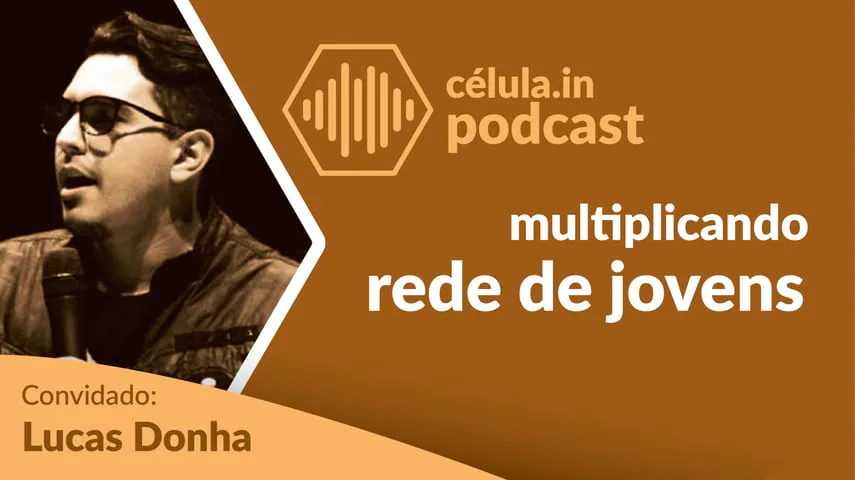
Lucas is a youth pastor at the Love and Care Church in Araçatuba, São Paulo, and, together with his wife Daniele, they are leading the Youth Alive ministry.
In this episode we chatted with Lucas about the multiplication of youth networks. We talked about contexts and realities in which specific work aimed at young people and adolescents is necessary.
Lucas told us the story of youth in Love and Care, sharing the difficulties and strategies employed in creating and maintaining the Youth Alive ministry.
Summary
A youth network multiplies the same way the rest of the church does: a group that grows, a leader who steps up and supervision that stays close. At Igreja Amor e Cuidado, in Araçatuba, that took two youth groups to nearly two hundred, says Lucas, the pastor of Juventude Alive, in this célula.in Podcast interview.
The youth work got a region of its own when the church stopped being a church with cell groups and became a church built on them. On reaching 106 groups, the region was multiplied into two: one for young adults and university students, another for teenagers, following the affinity that already existed between leaders and their people.
The single youth service was multiplied as well, into three profiles by age. The reason was not the message, it was the room: teenagers, single young adults and married ones all in the same place. According to him, the people who had been avoiding the service came back.
Two cautions he stresses: call the move a multiplication and never a division, and have each service keep mentioning the other age groups, so it does not turn into a contest between them. And the next target is not the service, it is supervision, which is where growth stalls.
Listen to it at:
Listen to it at:

Tell us a little about how you got to where you are today, as the pastor leading the youth at Amor e Cuidado.
I am the pastor of Juventude Alive, the youth ministry of Igreja Amor e Cuidado, led by pastor Marcelo Toschi, our pastor.
It started in 2009, when I began leading. We were not a cell church yet, we were a church with cells, it was one ministry among others. Even so the cell started to grow, it reached 30, 40 young people and teenagers, and that is where I had my calling confirmed, to win souls and care for people.
Then I went to seminary, I was there three years, from 2010 to 2013, and came back to work at the church with the youth, alongside the pastor. When I came back I was meant to lead the teenagers, but while I was at seminary another leader had arrived, so I came in as assistant to the youth pastor. Later that youth pastor stepped away, left the church, and I carried on with the ministry.
In 2015 I was ordained. I took over a supervision, the same supervision I had left behind earlier: I had left a cell, it grew, it became a supervision, and when I came back I took it over. Even while I was at seminary, during the holidays I always kept in touch with them, because I already had that sense of direction.
And from there the growth began. In the middle of all this the church needed a pastor for the red region, and I pastored that region for a time. Later, as a matter of maturing, I went back to the blue region, which is the youth region.
So I have been a pastor for three years, but I have been at the church since 2013 working with the ministry, growing, learning, and today I get to care for these people.
In those early days, when the church was not yet a cell church but had cells, was there any focus on cells aimed specifically at young people?
I think there were 8 or 9 cells in total, which is small. God gave the pastor this vision for cells through people who were already working that way, he started to follow it, started to walk alongside them, and from then on cells stopped being one ministry and became the life of the church.
We had five or six adult cells here and two very specific youth cells. That is where the blue region was born. We work with colors here, so blue became the region for youth cells.
That was when the prototype cell was created, at the very beginning, when the regions started, so the work could be better organized. That is where the blue, yellow, green and red regions were born, the church's four regions. It was around 2011, 2012, because I was still at seminary. The regions were formed during that transition, and the blue region became the youth region.
When I left seminary and arrived to work at the church, there were already around 50 youth cells, they had multiplied a great deal. But at the start it really was just two cells, and those two had a youth profile, people younger than me. The church's other cells, which were also few, were mostly adults.
So would it be fair to say that the movement of teen and youth cells started along with the church's own migration to the cell model? It was not something set up specifically for young people?
It began intentionally with the church's own move, going from a church with cells to a cell church. And having a region specifically for the youth was intentional, because of the contact, because of the affinity, young people with young people, the shared language.
And the youth cell regions are the purple one and the blue one?
That is right, we started with the blue one. The exact number was 106 cells: when we reached 106 cells, our pastor felt the need for one more region in the church. We had four regions and he felt we needed another, to organize things, to spread the work out. So we multiplied the blue region into the purple one.
The blue region ended up with a younger profile, university students, from nineteen to about 30 or 35, and the purple region ended up leaning more toward teenagers. And that came naturally from the people themselves: I was already with the slightly older group and Giovani was already working with the teenagers. He is a young leader and so am I, we are leading people who are practically our own age.
Before reaching that number, did leaders emerge organically through the multiplications, or was there a point where you strategically decided to raise up leaders from a particular age group?
Very organically. The cells kept multiplying, multiplying, like any youth region. We had some slow patches, which is natural, but the multiplication was natural, organic, nobody was raised up simply to move up a level.
We do have a structure for working with the youth: there is the pastor, the supervisor, the district coordinator, then the cell leader, and on down to the cell member.
Giovani, for example, was already a district coordinator, he already had 48 cells. And I have another district coordinator, Danilo, so there are two district coordinators. Since Giovani already had that profile, with his group being more teenage, that is when our pastor Marcelo made the decision to multiply the group.
We took the challenge and it was very good, because we went from 100 cells to nearly 180 now, counting both regions. I am reaching 100 cells at the end of August and Giovani is heading to 78 cells, nearly 80 as well.
That is enormous growth: from two cells to 50, to 100, and now nearly 200. You had a service specifically for young people, separate from the church's main service. With that growth, did you see the number of young people at the service grow too, or was the growth only in the cells?
We always had the youth service. Pastor Marcelo arrived, brought a new vision to the church and felt the need for a youth service. At that point I was not even a pastor, and the church did not even have a youth pastor. The migration to the cell model was a few months away and the youth service already existed.
This was 2008 into 2009. Pastor Marcelo had been a youth pastor at another church, so he arrived here and felt that need: the church needs young people, and a strong youth presence. He started working on it, and the cells existed too. The cells kept growing, but they were two separate things: cells and the service.
When we moved into the cell model, we understood that they are two wings, cells and celebration, and the two need to move together. So when I took over the pastoring, we had a large number of cells, 78 already, and we reached 100. When we got there, we started to notice how few people were at the service: the number of people in cells was not reflected in the service. We have around a thousand people in cells, more or less, and an average of 200 at the service.
That caught our attention: something is wrong, we need to do something. And we could not see where the mistake was, where the problem was.
Until I started coming under some influences. One of them is pastor Marcos Madaleno, from Igreja da Cidade, in São José dos Campos, from their youth ministry. I started meeting people who were living something big, something new, a revival among young people, and I began following them, began reading. One of those inspirations was this idea of multiplying the services, of creating an environment for each age group.
I took it to our pastor, who already had the same sense of it. We talked and he challenged me to do it quickly. When I went to him and said I needed to multiply the celebrations, I brought the idea and said we were thinking of doing it around November or December. This was roughly in May. He said: son, great, let us do it, but here is the thing, let us do it now, in August. He threw down the challenge and I said all right.
So, taking care with the transition, I prayed for God to give me a strategy and I preached a series of four messages under the theme Challenges that move me, working through the challenges we are given and that we need to move for. I move for a reason: I move because I know what Jesus did for me, because I know what awaits us, eternity, and because I want people to be transformed and saved by the love of God.
I preached that series of four messages, and in the last one I addressed multiplication. We held a prophetic act in which I explained what was going to happen: from that Saturday on we would no longer have a single youth service with everyone together, but a service for each age group, running at the same time.
So I raised up Giovani, who already cared for the teenagers. The teen service was already on Friday and mine was on Saturday, so there were two services; we brought everyone to Saturday and carried out the multiplication. I raised up a leader for Alive Way, the service for those over 30, the more mature ones, and a leader for the couples group, which is A3.
We have four age groups here, and we are working hard to strengthen A3. We held a specific service for it, a prophetic act where each leader would be with their own people, right there in the middle of the church: each age group, you teenagers go there, you young adults come here, you older young adults go there, you couples go there. And I was not the only one preaching, the age group leaders preached too, each giving a point from the Word about multiplication. And from there we began the multiplications.
We had around 180 people at that service, and from the following Saturday we held the services on the campus. We have two good spaces, the campus and the downtown campus, which is the church where we used to gather. So three services were running at the same time.
And it was supernatural, because within two or three months we went from an average of 200 people at our service to almost 500. Today, when there is no event, no wedding, nothing, we reach nearly 600 young people every Saturday across the three services.
Alive Livre, which is the 19 to 29 group, has more than 300 people, 290. Alive UP, the teenagers, averages 130 to 150 people every Saturday. And Alive Way, for those over 30, averages 50 people, a ministry we are only now starting to work on more specifically.
The couples ministry was very strong a while back, but then our leaders had to step away and it paused for a time. We are restarting A3 now, which is for dating and engaged couples. That one is monthly rather than weekly, while the others happen weekly at the three locations.
Did the idea of splitting a single service into several by age group come from watching another church, or was it something you noticed here?
I already had a discomfort inside me: I did not know why people were not coming, given how many were in cells. And talking with some pastors and leaders around Brazil, talking with my pastor and with my leaders too, we began to see that people were not dissatisfied with the service itself, but with the environment: it was too mixed. Teenagers, young adults and older young adults, all mixed together. And there are sometimes tensions among them, because our age range runs from 12 to 30.
And the message being preached does not always fit everyone, so perhaps it needs to be focused for each age?
That is exactly it, it is the message and also the service itself.
Speaking a little about what we do at each location: we have three profiles. There is Alive Way, for the older group, which is somewhat like the Sunday service, a calmer service, not much fast music, with certain moments, like the moment to welcome someone attending for the first time. It is not the service you look at and say this is clearly a youth service, it is more mature. But that more mature group is inside the youth ministry, led by a youth leader, following a youth approach, it does not lose its identity.
Then we have Alive Livre, which is more of a middle ground, mixing the teenagers and the older young adults somewhat, aimed more at university students. We have some interventions, it is livelier, it catches attention with different things, panels, specific themes. We work a lot with video, it is an age group that asks for some of that.
And we have Alive UP, for the teenagers. The teen service is a bit shorter, because a teenager cannot sit still for long, their attention span is shorter. There is worship and the message, we do not lose the essence, but it is shorter.
And at the end of all these services there is something called War of the Tribes. It is a strategy our teen leader, Giovani, came across, liked a lot and adopted. Because, as they say, we cannot patent anything, but we can copy. We copy and adapt it our own way, take our own particularities and adapt an idea that already exists.
This War of the Tribes is great and has drawn a lot of teenagers in, it has brought teenagers, they really enjoy it. It is like a field day, but we do not call it that, the name is just camouflage. And it is good because they compete, there are football matches, all sorts of things through the year, and at the end there is a teen camp where the final challenges and the prize giving happen. Two teams compete against each other, no fights break out, no arguments, it has flowed very well and brought in many visitors.
So it is a lively service. But this matter of age groups, each one in their own age group, has produced a lot of results.
Was it well received by the young people in general, or was there any resistance?
It was very well received, genuinely well received. What happened is that the young people who used to stay away out of some resistance started coming, started falling in love with the service, and today they attend regularly. It has been very good.
Did you run into difficulties with this multiplication? What were they and how did it go?
We had one difficulty, which was working out which activities we would use to equip people: what we would use, what strategy for each age group. Because we stepped out in faith, and we did not have the ideas yet. Then, in the middle of the process, the ideas started to flow: how to run the service for young adults, the service for teenagers, the service for older young adults. That was one of the difficulties.
Another difficulty was with one of the age groups, the over 30s, the most mature one. Someone who is 28 or 29, already married, does not lose the essence of youth, but it is different for him. So, for instance, we started with about 15 people and stayed there, we kept the same 15 people. We held the service, we worked and worked at it, and we saw it was not moving, it still felt somewhat stiff.
Then, a year into working with the multiplied youth ministry, we had a cell meeting and afterwards a few of us leaders stayed out at the farm talking into the night. That is where the idea of changing the name was born, because people already associated that name with something else, it already carried that culture.
So we changed the name, we prayed there, we asked God, we put a team together, and within six months we went from 15 people to 50 or 60. There have been days, when we hold a specific service, an event to bring people in, when we reached 200 people. But the average is 50 to 60. That shows how much having a clearly defined identity matters.
It is marketing, in the good sense: sometimes you frame something in a way that leaves people feeling unrepresented. Did changing the name help strengthen the leadership, create more identity, give that service new life?
Precisely. The people in the cells started to see that there was a service, and they started to understand it.
I am working hard with the cells, doing work with the supervisors, because everything sits in the supervision. Every cell church knows that the key to growth is breaking through at the supervision level, so having good supervisors is a supernatural thing. I am working hard with supervisors and I am telling Giovani to do the same, because we have targets: I want at least 60 percent of my cell people attending the service. That is still a dream, and we have been working toward it.
In splitting Alive up, was there ever any sense of parochialism, of rivalry between the tribes?
At the start there was no parochialism. Why? Because I made it very clear in the message series that we were not dividing, we were multiplying, and multiplying in order to bear new fruit. I explained that thoroughly.
And my leaders, who are at the front of each age group, have a very strong connection. So much so that I instruct them to keep mentioning all the age groups in their own service, to include something from the others somehow: if you are over 18, this is just one specific age group, you are part of our youth ministry, we are set up this way to make things easier, to help you who are a teenager. So we keep working on that unity.
Then later, about a year into the process, some joking started. And we woke up to it, because from time to time we hold a united service with everyone together. Usually when there is an event at the church, when there is something specific that cannot be done at separate locations, and sometimes strategically as well, precisely so people do not lose that unity, so they understand they are part of the youth ministry as a whole. Like the conference: we hold the youth conference where all the young people of the church gather.
So at first there was none; later came some joking, and we know that division can be born out of joking. But it was quite subtle, nothing explicit.
Is there a minimum age for someone to start leading?
Not really. In our church we even have children's cells, which is lovely. Of course the children's cells are led by adults, but some children are already at a good age, 11 or 12, and are beginning to take on a leadership role. There are children's cells where the leader is an adult, naturally, but with a child as a leader who is being prepared for it.
So within the youth ministry itself, from the age of 12 a person can lead, because that is already the teenage bracket. We have 90 percent young adults in the blue region and about 10 percent teenagers; and in the purple region, ninety percent teenagers and 10 percent young adults, a little more now, because the purple region crowd is transitioning into young adulthood. But they will stay in purple, they will not leave purple, because the cell region does not depend on the service.
Now, at the service, if I have a leader transitioning from teenager to young adult, he will start coming to Alive Livre, he will start making that transition. But in the cell he stays in purple. For the purple and blue regions, from the age of 12 people can lead, and we have plenty of leaders like that, closely supported, of course.
So there is no institutionalized transition: as someone grows up, they are not required to change regions?
Normally Giovani, who looks after the teenagers, is in close contact with Patrícia, who is the children's pastor. Sometimes a group of children moves up from the junior ministry to the teenagers, and sometimes a whole cell goes.
In the same way, sometimes a cell in an adult region, which would be red, yellow or green, has a younger profile, people aged 19 or 20. So we pastors talk among ourselves and sometimes make the change: the person moves with his cell from the yellow region to the blue one, or from another region. We have that friendship between the pastors, there is no rivalry, no turf war.
But there is no church mandated process, no transition where someone is told that now they must move. There is none, when it comes to cells.
When it comes to the service, in the case of the youth ministry, we do work on the transition: the teen leader himself works at it, saying that anyone turning 19 will move up. It is a natural thing, that understanding is already there. Because teenagers are like rabbits, they multiply fast. So in time a person realizes that service no longer suits him, he feels the need for a more mature service, one aimed more at him. That is normal, it has been happening.
Since it has not been long, the teenage group is still growing, but some are already saying they are thinking of moving to Alive Livre. Just as some people from the junior ministry have already moved up to the teenagers. It is guided by the leadership, nothing formal: the leadership guides and people follow. So it has been good work.
Given the reality you live in, is there any move already planned for the coming months or years, to change this structure of services and multiplication?
Not yet. Our focus right now is the age groups and working with the cells, because we have not hit the targets we want to hit. We reached a very good number, but we want more. There are still many young people who do not attend the services, and that is not about the services now, it is about the supervisions, about them announcing it, showing people there is an environment for each age group.
We are in the middle of a process: it has been two years since we multiplied the celebrations, and we are still in that transition of getting the people who are in cells to attend the services. Because we also have the Sunday service, which is the church's main service, and we do not compete with Sunday, there is no way, nor would we want to. Sunday is Sunday, it belongs to our church's pastor, we are very conscious of that.
Those who are young we are trying to bring into the youth environment, not so there is competition between services, but so there is a language in which I can speak to my people and Giovani can speak to his people every week. Just as pastor Marcelo can speak to the whole church every Sunday across the four services, I want to be able to speak to all my cells on Saturdays, and not only to part of the region.
We also hold the regional service, on a Wednesday: there are no cells that day, everyone comes to the church and we hold a specific service. So I want that reach, and not only me but Giovani, and Alan, and now the couples leader, with whom we are already working to restore that ministry.
That is our focus. We do not yet have a vision for a move to serve some other segment. We have ideas, dreams: we could hold a youth service in English, but that is still in the dream stage.
Leave us some advice, a word of encouragement for youth pastors.
The advice I want to give everyone listening is this: youth ministry, ministry with young people, is a ministry of the church. We are inside a Kingdom, we are part of a Kingdom, we are not here to build empires but to glorify and worship the one King, who is Jesus Christ.
So, you who lead young people, you who work with cells: be in covenant with your church, be in covenant with your pastors, hold that vision very clearly inside you, love them, be obedient to them. And do not stop, do not stop growing, do not look back, do not run a maintenance ministry, run a multiplication ministry. Jesus told us to advance, to make disciples until he returns, and that every day he would be with us so we could make disciples. Work that way.
Youth leader, you need to understand your position, and if you do not understand your position you will not fulfill your purpose. Our position is to influence our generation, so that Brazil becomes a better country, so that people give themselves to Jesus first of all, of course, and so that we can truly fulfill our calling.
I believe there are people in the mud, people in sin, gone astray, lost, and the Lord placed us here to make a difference. So let us lead, train leaders, win as many people as possible, never lose the passion and never settle for a maintenance ministry, but for a ministry of multiplication, of growth.
And there is one more thing I have learned: I cannot be the Holy Spirit. I have to bring my young people, my leadership, the people under my care, close to the Holy Spirit, and the Holy Spirit shows them the way. So do not try to do it in your own strength, do it in the strength of the Spirit. Be a friend of the Holy Spirit, show the Holy Spirit to people, lead your sheep close to God.
I see many youth leaders who try to do it by their own arm, but whatever is done in the flesh reaps corruption from the flesh; what is sown in the spirit reaps from the spirit. So bring your young people close to Jesus, and then they will work more, love more, be more passionate, and you will multiply exponentially. That is what I have been learning. I am not one hundred percent there yet, but I am working and growing toward it.
 Facebook
 WhatsApp